Showing posts with label COMPLETED (MADE CHANGES AFTER COMMENT). Show all posts

Thursday, 23 February 2012

Flexible Working

The opportunity to have flexible working hours has always been around because sometimes unpredictable circumstances arise that requires employees to take leave or change their shift pattern. But now flexible working is becoming more and more popular and more people are seeking flexible working hours in their jobs. This gives them the chance to do other things, such as looking after relatives young or old, having extended holiday leave and taking a break from their working career. (Stredwick and Ellis, 2005)

More employers are now offering their staff flexible working as the normal nine to five routine is becoming less popular. Employers offer their staff flexible working in the form of job sharing, annualised hours, term time and home working, extended leave and short-term working and other ways that increase the flexibility of the employee. This gives their employees more flexibility between their working and private life. (Stredwick and Ellis, 2005)

John Lewis
John Lewis gives their employees the opportunity to take a 12 month leave from work. This gives the employees the chance to have a break from their career and have a secured job when they return after their 12 month leave. (BITCDiversity, n.d.)

This benefits the employee as they can take a year break from their career to do other things in the knowledge that their job is secured for them when they return to work. This means that the employee can either take a long holiday and relax for a year before continuing with their career or move on to do other things. (BITCDiversity, n.d.)

This benefits John Lewis because they believe that after their 12 month leave, the employee will be more motivated when they return. This would increase their productivity and help them become better at their job.


McDonald's
McDonald's run a family flexibility scheme. This is where family members, working at the same McDonald's restaurant, can switch shifts with one another without prior notice. (BITCDiversity, n.d.)

This benefits the employees of McDonald's because it allows them to switch with another family member if they need time off. This increases their flexibility and allows them to have the ability to fit in their private life as well as their working life. (BITCDiversity, n.d.)

This scheme benefits McDonald's because they would see a reduction in the amount of absentees within the workplace because employees can swap with other family members without prior notice.


BT
British Telecom offers teleworking. Teleworking is where you can work from the comfort of your own home. This means that you can work from home and fit your work life arround your private life. (BT, n.d.)

This scheme benefits the employee because it gives them a chance to plan their work life around their family/private life. Working from home would, for example, mean that mothers or fathers can pick their children up from school and save money on childcare and students would be able to plan arround deadlines.

This would also benefit British Telecom becuase they would see a reduction in the amount of time off their employees would require; increasing their productivity. This would mean that BT wouldn't have to find as many new staff to cover for people when they need time off.


Forms of Flexibility

Numerical Flexibility
This is where a company or organisation increases or decreases its headcount to meet customer needs. This is most common in retail as companys tend to employ more temporary staff before christmas to deal with the increase of customers. (Reilly, 2001)


Advantages to Employer
 Advantages to Employee
The employer can reduce the number of employees when they're not needed; Helping to reduce costs.

Gives the employer the ability to employ more staff during peak times to help with an increase of business.

More flexible working for example, students, as they can be employed out of term time and then return to their studies.

One disadvantage of numerical flexibility is that constantly increasing and decreasing head count means that the recruitment costs are increased because the employer is contantly looking for new temporary staff. This could be very expensive for the business.

Another challenge caused by numerical flexibility is that the line manager will have an increased work load as they will have to organise the increasing and decreasing work force and plan ahead to make sure the business is runng effectively.


Functional Flexibility
This is where employers train their staff so that they are multi-skilled and can switch between jobs. This is also common at supermarkets where employees may be require to fill up stocks, work on the tills and other jobs that are required.
(Reilly, 2001)

Advantages to Employer
Advantages to Employee
The employer can employ less staff because their current staff can undertake a variety of different jobs; this will save the employer money.

If someone is off sick, or on holiday, the employer would have a wider range of employees to ask to cover the required shifts as each employee has a variety of skills.

The employee will have more job satidfaction as they will be able to complete various different tasks and will be highly trained.

One disadvantage of functional flexibility is that training costs could be quite high as every employee needs to be trained to do a variety of different jobs. This could lead to very high recruitment costs.

Another challenge that line managers would have to overcome would be the work overload. By reducing the amount off staff and increasing the jobs that staff members can complete may cause employees to become overworked. This would reduce their productivity.


Financial flexibility
This is where the pay and rewards employees receive differs between groups. For example, part time workers may not get the same benefit packages or pay as full time workers. This can also be in the form of performance related pay.
(Reilly, 2001)

Advantages to Employer
Advantages to Employee
The employer could save money by not offering the same benefits package to all employees.

Employees could receive a benefits package that is more suited to their needs rather than having the same benefit package as all the other members of staff.


One challenge that might arise from financial flexiblity is a split between the workforce. The workforce might split between different pay and might not get on with each other. This means that they wont work as well as a team as they might have disputes between one another.

Another challenge that faces the line manager is how he splits his workforce. He will have to work out a way to split his workforce to make sure everyone is treated fairly and to make sure that everyone gets the benefits they require to maintain their motivation.


Locational Flexibility
This is where employees are employed to work in one place but can be asked to work in a different location. This can also include homeworking; where employees can work from home. (Reilly, 2001)


Advantages to Employer
Advantages to Employee
The employer can choose which location they want their employees to work in. This would enable the employer to delegate his workforce to locations that require more staff due to increased business and away from locations where all the staff arent always required.

The employer wouldn't have to employ as many staff because they can just relocate some staff from other areas of the business. This would reduce recruitment and training costs.

The employee benefits from locational flexibility because they can have the option to work from home. This helps the employee with their work/life balance.

THe employee would also be able to apply to work in a location closer to their home. This would reduce the employees commuting costs.

One challenge the line manager might face when using locational flexiblity is that employees might not want to change their work location because it maybe unsuitable for them or it might increase their commuting time/costs.

Another challenge that line managers might face would be that staff begin to feel isolated. Especially when working from home, staff can feel isolated from other work colleagues due to the lack of face to face communication. This may reduce the employee's productivity.


Temporal Flexibility
Temporal flexibility is where employers alter the work hours of their employees to enable more efficient use of their labour force. This can be done by increasing or decreasing their current staff hours on a temporary basis to deal with an increase or decrease in business. (Reilly, 2001)


Advantages to Employer
Advantages to Employee
The employer can save money by asking their staff to work longer hours instead of recruiting more temporary staff to cover the work load.

They have the ability to deal with an increase in business with little organisation.

The employee can have the opportunity to increase their working hours.

One challenge that may arise from using temporal flexibility is that staff might not want to increase or decrease their working hours. This means that the employers would have to find someone else to cover the workload; costing them time and money.


Problems that may arise
One challenge that effects the line manager with any of the different forms of flexibility is the increased work load for the line manager. Whatever form of flexibility a line manager chooses to implicate with its workforce, will result in an increased workload for themselves. Organising any form of flexibility would take a great deal of organisation from the line manager.

The line manager would also have to deal with the day to day issues that are caused by the different forms of flexible working; increasing their workload further.

Bibliography


BITCDiversity (n.d.) Flexible Working John Lewis Partnership [online]. BITCDiversity. Available from: http://www.bitcdiversity.org.uk/best_practice/exemplar_employers/flexible_working/case_studies/jlp.html [Accessed: 23rd February 2012].

BITCDiversity (n.d.) Flexible Working McDonalds Restaurants Ltd [online]. BITCDiversity. Available from: http://www.bitcdiversity.org.uk/best_practice/exemplar_employers/flexible_working/case_studies/mcdonalds.html [Accessed: 23rd February 2012].

BT (n.d.) Benefits [online]. BT. Available from: http://www.btplc.com/Careercentre/WhyjoinBT/Benefits/Benefits.htm [Accessed: 21st February 2012].

Reilly, P.A. (2001) Flexibility at work: balancing the interests of employer and employee.

Stredwick, J. and Ellis, S. (2005) Flexible Working. 2nd ed.


Monday, 16 January 2012

Conflict

What is conflict?

Conflict within a group is where a task or outcome can not be accomplished or completed due to peoples disagreement. Conflict can arise due to several different reasons including a difference in culture, gender, personality style, or people being too stressed out or over worked. (Diamond, 2011)

Conflicts can potentially lose businesses money and/or waste their assets or stock. If a conflict occurs between staff, then they wont be working effectively or efficiently so the business could suffer. Team leaders need to be able to reduce conflict as much as possible in the workplace to ensure that tasks get carried out effectively and efficiently; if they don't, then tasks may go unfinished.


Whilst studying my A-Level business course we were asked to complete a group piece of coursework with two of our classmates. At first it was going well and we worked effectively to complete a couple of tasks within the coursework. After a while we began to get different ideas as to what we should include in the coursework assignment.

To reduce the conflict within our group we had a meeting and discussed as a group what we should include in the coursework. We put our points forward and we eventually decided to collaborate all of our ideas that we all thought were relevant into our coursework. This meant that we can include all of the information that each person thought was relevant.

To prevent future conflicts within the group we looked at each individuals skills and worked out who was going to undertake each task to make sure that we could get the best possible outcome without any further conflicts.

French and Raven's different 'Sources of Power'

French and Raven believe there are 5 sources of power that people adhere to; Coercive, Reward, Expert, Legitimate, and Referent power. These different sources of power are the reasons why people obey the instructions of the people who possess one or more of these 'powers'.
(Levy et al., 2010)
Coercive power:
Coercive power is when someone can control someone else because they are believed to have the ability to punish people who do not comply. (Lee-Chai and Bargh, 2001)

For example, police have coercive power as they have the power to arrest and detain people who do not do what they say. If people do not comply with a police officers instructions then the police officer can punish them. This gives them the power they need to complete their job.

Reward Power:
People obey instructions from people with reward power because they feel like they will benefit as the instructor has something to reward them with. This is most commonly found in the workplace as employers can reward employees financially for undertaking work. (Lee-Chai and Bargh, 2001)

For example, an employee in Sainsbury's would obey instructions from their manager because they get financially rewarded for working. If employees did not obey the instructions of their manager, then they might get disciplined, then leading to their dismissal. This means that if the employee doesn't do the work that is asked of them then they will not receive their financial reward.

Expert Power:
People obey instructions from people with expert power as they believe that they have more experience, skill or knowledge of the subject. This is commonly found with architects. People employ architects to help them build a building or structure as they have the desired skill, knowledge and experience to help them complete their build. (Lee-Chai and Bargh, 2001)

An example of someone with expert power would be architects. Architects get employed by people to help them build a building or structure. Architects have expert power as they are more experienced, they have more skill, and more knowledge than their client. This gives them power over the client as they know the subject a lot more than the client does.

Legitimate Power:
People with legitimate power can control others because they are believed to have the right to give orders to others and expect compliance and obedience. Legitimate power often comes with the job role or title rather than the person themselves. This means that legitimate power can vanish if the person loses their job role or title. (Lee-Chai and Bargh, 2001)

An example of someone with legitimate power is the CEO of a business. They hold this formal, official positions and often get their power through the organisational structure. People believe they have the right to demand as they created the business and are at the centre of the organisation structure.

Referent Power:
Referent power is often acquired through the persons appeal, admiration, charm and charisma. People gain referent power through respect. Referent power can be easy to acquire and you may not have to do anything to get it. As well as being easy to get referent power is also easy to lose; as soon as people lose respect for someone, they lose their referent power. Someone with referent power looking for long term power would need to combine referent power with another source of power as referent power isn't a reliable source of power. (Lee-Chai and Bargh, 2001)

An example of people with referent power are celebrities. Through peoples respect for celebrities, they are able to influence people about the decisions they make such as the brands or products they buy.
Recent News Stories

The National Institute for Health and Clinical Excellence (NICE) conducted a report looking into work related stress, what the causes are, and how it effects Britain's businesses.
This news article explains the findings of the report conducted by NICE. The report goes on to say that more than 13 million working days a year are lost because of work related stress, which equates to £28.3bn a year lost by employers.

The report also shows that "Bad managers were the single biggest cause of problems" (BBC, 2009) This relates to conflict between different roles in a business. According to Mullins, one source of conflict is between peoples roles in the business as this is often gives people different perspectives; causing disagreements.(Mullins, 2010)


Conclusion

Team leaders in a business need to keep conlict to a minimum to make sure the business runs smoothly. If conflicts within the workforce aren't addressed properly then the business could lose money, stock, or assets. For team leaders to effectively sort out conflicts, they need to be able to control their employees; this means they need power. All of French and Ravens sources of power are effective in their own way and all ensure power over subordinates.


References:

BBC (2009) Tackle Work Stress, Bosses Told [online].BBC Available from: http://news.bbc.co.uk/1/hi/health/8343074.stm [Accessed: 15th January 2012]

Diamond, A. (2011) Conflict in the Workplace: Causes and Cures.

Lee-Chai, A.Y. and Bargh, J.A. (2001) The use and abuse of power: multiple perspectives on the causes of corruption. illustrated ed
Levy, D.A., Parco, J.E. and Blass, F.R. (2010) The 52nd Floor: Thinking Deeply about Leadership.
Mullins, LJ. (2010) Management & Organisational Behavior. 9th ed.

Wednesday, 7 December 2011

Organisation Culture

Visible Aspects

The visible aspects of culture in a business is what everyone can see when they enter a business. For example, the way people dress and behave, and the layout and condition of the room are all visible aspects of a business.

In the Co-operative, the staff all wear the same uniform, a Co-operative top and smart trousers and shoes. This helps customers recognise the staff and also gives the Co-op a professional look. If the staff at the Co-op didn't wear uniform, it would be hard for customers to differentiate between staff and other customers. It would also show that the co-operative lacks professionalism and lacks quality. This is one visible aspect of the culture at the Co-operative and shows what the culture is like in the business.

The staff are also expected to work in a professional manner. This shows the customer that the Co-operative maintains a high level of service and sells high quality products. If staff didn't act in a professional manner, then customers might doubt the level of service that they receive from the Co-op. This is another visible aspect of the culture at the Co-operative.

The layout of the shop is also another visible aspect of the culture at the co-op. The shop is organised in a specific way to help staff and customers navigate themselves around the shop effectively. This shows customers and employees that the culture at the Co-op is organised. This shows that the culture at the Co-op is organised. If the layout was bad, it would show that the Co-ops culture isn't organised.

Another visible aspect of culture at the Co-operative is how clean and tidy the shop is. The shop is kept clean and tidy at all times. This shows customers that the Co-operative is high standard and sells high quality stock. If the shop was untidy or unclean, then customers would doubt the quality of the products. This would also show that the Co-operatives culture isn't to a high standard.


Handy's 4 Types of Culture

Power Culture:
A power culture consists of one or more central figures who have all the power and make all the decisions. Because of this, decisions are made fast and other employees are told what to do. There isn't many rules and systems in place because the staff do what they're told, when they're told. Communication is minimal and instructions are passed down to employees. (Naoum, 2001)


An example of a business using Power Culture is a Family run news agents. The employees are told what to do and dont necesserily work to a specific job description, inctead they do what they are told, when they are told. Communication is very much one way as employees have very little input into the decision making and are rarely given the chance to make their own deicisions. This means that the owner of the small family run business makes all the decisions, this means things can be done quickly and how they like it.

Role Culture:
A role culture is usually used in bureaucratic organisations where employees work to a specific job description. Power is more spread out throughout the business and is based on level in hierarchy. There are also possibilities to progress up the hierarchy. In businesses with a role culture, work is often decided to abide by rules and regulations. (Martin and Fellenz, 2010)


An example of a business using Role Culture is Sainsburys. In Sainsburys, there is an obvious hierarchy and employees work to a job description. There are rules and regulations that often influences the tasks they carry out, such as making temperature checks and checking use by dates on products.

Task Culture:
A task culture is usually found in project based businesses. They rely on teamwork from various different teams, often from different businesses with different skills. They all work together on a task and they all focus on the task to get it completed instead of focusing on an individual. (Martin and Fellenz, 2010)


An example of a business using Task Culture would be a housing developer. They employ various different teams of people with various different skills. They all work towards completing the task (Completing the houses). There isn't much of a hierarchy as each team has different tasks to do and carry different responsibilities.

Person Culture:
A person culture is usually found in very small businesses with only a few employees. These businesses usually exist to serve the interest of those within it. In a business which has a person culture, there is no hierarchy as the business revolves around the individuals inside the business. (Naoum, 2001)


An example of a business using Person Culture would be an architect firm. The firm exists to serve the interests of the architects inside the firm. There is no hierarchical structure and the business revolves around the architects.


Possible Problems of Handy's 4 Types of Culture

Not all businesses will fit into one of Handy's 4 culture types. Every business has a different structure as to how they run their business, some businesses might have a mix of two or more of Handy's types of culture. This shows that Handy's 4 culture types doesn't fit every business as every business has a unique organisational structure and culture that it adopts.


Conclusion

Visible aspects of a business can strongly show visitors how the business is run and can also clearly show the culture it adopts.

Although Handy's 4 types of culture can fit many businesses into one of its four types of culture, not every business will fit into one of the four. Some businesses may have aspects of more than one of the four types of culture. This means that not every business will fit into Handys 4 types of culture.

Bibliography

Martin, J. and Fellenz, M. (2010) Organizational Behavior and Management. 4th ed.

Naoum, S. (2001) People and Organizational Management in Construction. illustrated ed.

Saturday, 3 December 2011

Leadership

Differences Between Management and Leadership


Management and leadership are two completely different roles in a business. They undertake different takes and go about them in different ways. These are explained below:


Management
Leadership
Plan:Managers plan what the company should do and what course to take to make it successful. If the managers did not plan what the business was going to do, it would not work as effectively and would be more likely to fail as a plan is crucial.
Motivate:
Leaders motivate the staff. This makes them work harder and enjoy what they're doing. If leaders did not motivate staff, then the overall productivity of the business will be reduced.
Control:
Managers control their staff and make them work efficiently and effectively to achieve what they want them to do. If the managers didn't control what the staff tasks are, then the staff may not know what they're doing and tasks might get missed out.
Generate ideas:
Leaders generate ideas that the business can benefit from. This allows the business to progress and become more successful. If leaders did not generate any ideas, then the business might not progress and may not be as successful as it could be.
Co-ordinate:
Managers co-ordinate their staff to make sure everything runs smoothly, efficiently and effectively. If managers did not co-ordinate their staff, then their staff would not be organised, they might complete a task twice or even miss it completely.
Enthuse and Inspire:
Leaders enthuse and inspire the staff to work hard at their job. Similar to motivation, it persuades the staff to work hard and makes them want to complete their tasks quickly and to a high standard.
Implement policy:
Managers implement policy and make sure everything is being done correctly and nothing is getting missed out or overlooked.

(Adeniyi, 2007)

Managers focus on the business. They don't interact as much with the staff and have a low level of involvment with the day to day running of the business. Managers implement all the rules and regulations and make sure that all policies are being abided by. (Singla, 1993)

On the other hand, leaders are more people orientated and work more with the staff to increase the businesses productivity and efficiency. They focus all their attention on the staff and making sure they are working to the best of their abilities. Leaders are more personal with the staff, they communicate a lot more and encourage them to work hard. (Singla, 1993)


The Co-operative Leaders

There are several team leaders at the Co-operative where I work and they all have a dominant leadership style. This changes the way they work and the way they undertake the tasks they are given and delegate tasks out to their subordinates. (Adeniyi, 2007)

One leader at the Co-operative, Theresa, motivates staff to work efficiently and complete tasks quickly and then move onto the next task. She sets the pace and makes sure that all staff members have something to do and are working to the best of their ability. She was an effective leader because she managed her staff well and completed all the tasks quickly and efficiently by motivating the staff to work hard. Theresa fits in with Goleman's 6 leadership styles and her most dominant leadership style is 'Pace Setter'; someone who is always pushing to accomplish tasks. Although Theresas dominant leadership style is as a 'Pace Setter', she has the ability to adapt between leadership styles to get the most of her staff. (Ward, 1999)

Another team leader at the Co-operative, Lucy, she fits in with Goleman's 6 leadership styles. Lucys msot dominant leadership style is the 'Affiliative' leadership style. She makes the staff work together in teams to complete the tasks that need to be completed. She creates harmony at work by getting people to work together. She was an effective leader because she persuaded people to work together. This enabled them to complete tasks faster by working in teams. (Ward, 1999)

Another leader at the Co-operative is Mary. Mary liked to develop peoples skills by teaching them on the job. Enabling the staff to complete more tasks and using different techniques, complete them more efficiently. She was an effective leader because she developed peoples skills and enabled them to complete more tasks more efficiently and effectively. Marys most dominant leadership style is the 'Coaching' leadership style of Goleman's 6 leadership styles as she develops her staff. Mary can also adapt her leadership style to fit in with the situation shes given. (Ward, 1999)

Managers and leaders are both important roles that are essential to the running of a business. They undertake different sets of essential tasks and roles that without, a business would find it difficult to become successful.
Leaders can take different approaches and styles as to the way they lead their staff, all 6 of Goleman's leadership styles are effective and aim to get the best out of their resources and staff.


Bibliography

Adeniyi, M.A. (2007) Effective Leadership Management: An Integration of Styles, Skills & Character for Today's Ceos.
Singla, R.K. (1993) Business Management.
Ward, M. (1999) 50 Essential Management Techniques. reprint ed.

Monday, 17 October 2011

Improving Staff Performance

Content & Process Theories

Mary Simpson - Lecture notes - Week 3
Businesses use both content and process theories to motivate staff.
If a business uses 'Content Theories', then they assume that people already have a set of needs that they need to pursue. Content theories concentrate on WHAT motivates employees. The business then uses these needs to motivate their staff in stages. (Forsyth, 2010)


On the other hand, if a business uses 'Process Theories', then it assumes that individuals select their goals and choose how to get them by a process of calculation. Process theories concentrate on the actual process of motivation. The business then uses these to motivate their staff continually. (Mullins, 2005)

One of the process theories is the Goal Theory. This theory focuses on setting challenging yet achievable goals. This theory works because employees tend to work harder if they are set harder goals, than if they were set goals that are easy to achieve. For the goal theory to work, the individual needs to be involved in deciding what his or her goals are and they need to be committed to achieve their goals. This will lead to higher performance than if the individual was set general 'do your best' goals that don't relate to the individual. Another critical part of the goal theory is the need for feedback or appraisals. Without these, the employee won't get the motivation needed to complete the next task effectively and efficiently. (Mullins, 2005)

For example, an employee will work harder if he or she has a goal to take all of the stock out and fill up the freezers by 2pm, than if their goal was to take the stock out of the freezer. This is because the employee will have something to work towards and will aim to complete their tasks by a given time. If no time scale is set, then the employee will feel like they have nothing to aim for and can take their time. This will result in the employee not working to the best of their ability and will take longer to do the given tasks. The feedback and appraisals show the employee that they've done a good job and show them that their work is being recognised. Without feedback or appraisals the employee will get de-motivated as they will feel that their work is not being recognised. (Torrington and Weightman, 1994)


The Co-operative

The Co-operative use various different methods to motivate their staff.

The Co-operative use a competitive salary to initially motivate staff to come and work for them. The competitive salary motivates people to come and work for them instead of other companies because they know that they offer a good rate of pay. If the Co-operative didn't offer a competitive salary then staff might become demotivated and might choose to leave the Co-operative and work for someone else.

The working conditions at the Co-operative are above standard and are comfortable to work in. This also motivates employees to work at the Co-operative because they feel comfortable when they work there. If the working conditions were poor, then employees might become demotivated because they're not comfortable working in those conditions and might decide to leave.

The Co-op also provides all of its employees with a good reward scheme and benefit package. These also motivate motivate employees to keep working for them because of the rewards and benefits they receive. The benefits package includes discounts across the whole range of the Co-op services, including childcare, funeral care, holidays and discounts in their supermarkets and convenience stores. All of these benefits and rewards motivate the employees to stay working for the Co-op because if they leave and go to work for someone else, they wont receive the benefits that the Co-op offer.

To further motivate employees, the Co-operative runs social events to let the staff get to know each other better. These events help staff work as a team but also motivate them to work hard and to remain at the Co-operative. These events motivate staff to remain at the Co-op because it allows them to make friendships with the rest of the staff. This would make them enjoy work and make them want to stay working for the Co-op. Without these events, employees might not interact with each other. This means that teamwork between staff wouldn't be as effective. Employees would also be less motivated to stay with the Co-op because they haven't had the chance to develop any strong friendships with any of their colleagues.

The Co-operative use job titles as another way to motivate employees. The Co-operative recently changed the job title for all of the 'Supervisors' to 'Duty Manager'. This motivates staff to work harder because alothough their job hasnt changed, they feel more important because of their new job title.

At the Co-operative, they frequently offer promotion opportunities. This would motivate employees to work hard because they know if they work hard, they might get the chance to be promoted. This means that staff are more likely to try hard at work and make a good effort. Without any opportunities for promotion, employees might become demotivated because there is no opportunities to progress.


The Goal Theory

The Co-op use the goal theory to motivate their staff. SMART (Specific, Measurable, Achievable, Realistic, Time) goals are used by staff as much as they can to motivate employees.


<><> <><> <><>
www.co-operative.coop/food
The goals they set their employees are specific to the employee. This motivates employees because they know that the goal is their goal, specific to them. If the employee was set a goal that wasn't specific to them, then they might feel like the goal is unachievable; this might demotivate them.  (Mullins, 2010)

The goals are also measurable. This helps motivate the employee because they know whether they are achieving their goals or not. If the goals weren't measurable then the employee would have no idea whether they are achieving their goals. (Mullins, 2010)


The goals that the Co-operative are also achievable. This motivates their employees to work to the best of their abilities. If the goals weren't achievable, then the employee may become demotivated because they know they cant achieve the goals they have been set. (Mullins, 2010)


The goals are also realistic. The Co-operative set realistic goals so that the employee knows that they can be achieved if they work hard. This would motivate their employees to work to their full potential so they can achieve their goals. If their goals aren't realistic, the employee wouldn't work as hard because the know that the goals they're trying to achieve aren't realistic; leading to the employee becoming demotivated. (Mullins, 2010)


The employees at the Co-operative get goals with a time scale. A time scale motivates employees to work harder because it gives them something to aim for. This means that they will work harder to achieve their goals. If there was no time scale, then they employees might not work as hard and might take their time to complete their goals. (Mullins, 2010)


At the beggining of my research, I thought that the goal theory wouldn't be that important whilst motivating staff. As I conducted my research, I realised that the goal theory is a very good way of motivating staff. The goal theory is an effective way to motivate staff by using specific, measurable goals that are acheivable and realistic and can work with a variety of businesses and I found that the Co-operative use the goal theory a lot to motivate its staff.

Bibliography:


Forsyth, P. (2010) How to Motivate People. 2nd ed.
Mullins, L.J. (2005) Management and Organisational Behavior. 7th ed.
Torrington, D. and Weightman, J. (1994) Effective management: people and organisation. 2nd ed.

Thursday, 13 October 2011

Motivation

Maslow's Hierarchy of Needs

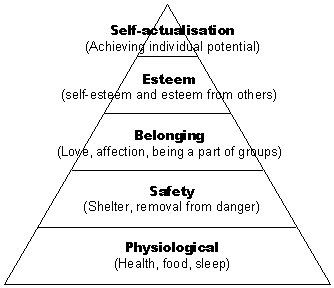
Maslows Hierarchy of needs is a theory of motivational factors that have been arranged into the shape of a pyramid. The pyramid has 5 different levels. Maslow believed that in order to become more motivated, you need to work your way up the hierarchy. (Koontz and Weihrich, 2006)

http://www.changingminds.org/
In the first level of the hierarchy is your 'Physiological needs'. These include your health, food, and sleep. These factors are usually solved by offering staff pay. Maslow theory shows that these factors motivate people, and enable them to move onto the next stage of motivation. On the other hand, if these physiological needs aren't met, then you cant move onto the next stage of the hierarchy. (Koontz and Weihrich, 2006)

The second stage of Maslows hierarchy can only be reached if the physiological needs are met. The second stage of the hierarchy is the 'Safety needs'. This stage of the hierarchy includes shelter, pensions, and job security. Once these motivational factors have been achieved, you can progress to the third level of the hierarchy. If these factors aren't achieved, then according to Maslows hierarchy of needs, you wont be able to progress to the next level of motivation. (Simpson, 2011)

The third level of Maslows hierarchy of needs is 'Belonging'. This section involves Love, affection and being part of a group. This is often achieved if you enjoy the people your working with. Once again, Maslows hierarchy of needs shows that without these motivational factors, you cant progress to the next stage. (Koontz and Weihrich, 2006)

The fourth level of Maslows hierarchy is Esteem. This includes self-esteem and esteem from others. This means that if your being praised by others, or believe you’re doing a good job then you will be motivated. Without these motivational factors, you can't proceed to the final level of motivation according to the hierarchy. (Koontz and Weihrich, 2006)

The fifth and final stage of Maslows hierarchy is self actualisation. Maslow believes that without any one of the previous stages in the hierarchy, this level cannot be reached. This final stage is where you think you have reached your full individual potential. (Simpson, 2011)

My Motivation

My motivation for starting a degree course isn't down to just one reason. I was motivated in loads of different ways, and they all relate to Maslows Hierarchy of Needs.

One of the main reasons why I decided to start a degree course was for the qualification. I know that if I turn up, and try hard throughout my course, I will gain a good qualification at the end of the course. This means that I will have the potential to get a better job once I leave university. This will provide me with the physiological and the safety needs according to Maslows hierarchy. This motivates me to a certain extent to attend lectures and seminars and work hard throughout my three year course.

Another reason why I decided to continue my education and start a degree course was to socialise and meet new people. According to Maslow, This motivates people as long as they have their safety and physiological needs met. This means that I will have reached level three in Maslows hierarchy of needs. This will help me stay motivated throughout the three year course.
Self esteem and esteem from others will also help me stay motivated. If I know that I am doing well in my course, I will be motivated to continue working hard as I know that I will get something out of it at the end of my course. According Maslows hierarchy of needs, this fits in with the fourth stage of the motivation hierarchy.

By using all of the motivational factors above, I will be able to motivate myself enough to try my hardest in every part of the course. This means that I will have Self-Actualisation. I will feel like I have been achieving my full potential and will be motivated to continue achieving my full potential. Maslows hierarchy of needs shows that this is the final stage of being motivated.

De-Motivation

When I was at school studying my A Levels, I became de-motivated in maths.

One of the main reasons why I was demotivated, was because I had no self esteem and very little esteem from others. I also didn't feel part of the group as I felt like I didn't belong in the maths course. I didn't have any self esteem because I felt like I couldn't do the work that was required and I had no esteem from others.

According to Maslow, this would prevent me from becoming motivated as I wouldn't be able to get past the second level of the motivation hierarchy as I'm not currently being motivated enough to progress up the hierarchy. I didn't feel part of the group because I felt like I couldn't participate in the lessons because I couldn't do the work. This means that I found it hard to get motivated past the second level of Maslows hierarchy.
Also, I lacked in self esteem, and esteem from others. This means that I wasn't able to reach the fourth level of Maslows hierarchy. This left me de-motivated.

http://www.envisionsoftware.com/
According to Aldefer's ERG theory I was limited and stuck in existence needs as I didn't have any motivational factors to help me progress to the relatedness needs. Aldefer's theory also shows that even if I do progress to the next motivational stage (Relatedness Needs), I would have to keep the motivators otherwise I would regress back down to the first stage and become de-motivated.
 (Koontz and Weihrich, 2006)


http://www.web-books.com/
Herzberg's two factor theory has two factors, the 'Hygiene factors' and 'Motivation factors'. Herzberg believed that in order for someone to become motivated, they already needed all of the hygiene factors. This means that if someone doesn't already have the hygiene factors, then they cant become motivated.
The reason why I was demotivated was because I didn't have all of the hygiene factors. I believed that I was incapable of completing the work, the teachers didn't support me and I felt like I wasn't keeping up with the group. This prevented me from becoming motivated. (Schermerhorn, 2011)


To get me more motivated, my teachers gave me some extra lessons. This increased the esteem I received from others and motivated me to work. The extra lessons also helped me to catch up on work. This made me feel part of the group again as I had caught up with them. Both of these factors helped me to become motivated.

If I was to re-do my A Level maths, I would ask the teacher for help as soon as I became stuck. This would help me remain motivated throughout the whole of the course. I would remain motivated because I would still feel part of the group because I will be able to do the same work as the rest of the class.

Businesses need to motivate their staff effectively. These theories are very important and should be taken into consideration when businesses aim to motivate their staff. If businesses do not relate to these motivation theories then they could go wrong when trying to motivate their staff. This would prevent their staff from becoming motivated and would stop them from working at their true potential.

References:

Changing Minds. (2002). Maslow's Hierarchy. Available: http://changingminds.org/images/maslow.gif. Last accessed 7th November 2011.


Envision Software. (2011). ERG Theory of Motivation. Available: http://www.envisionsoftware.com/articles/ERG_Theory.html. Last accessed 7th November 2011.


Koontz, H. and Weihrich, H. (2006) Essentials Of Management. 7th ed.

Schermerhorn, J.R. (2011) Exploring Management. 3rd ed.

Simpson, M. (2011). Motivation. People and Organisations. 2 (1), p1-23.


Web-books.com. (NA). Motivating Employees. Available: http://www.web-books.com/eLibrary/books/B0/B66/IMG/fwk-collins-fig07_006.jpg. Last accessed 7th November 2011